
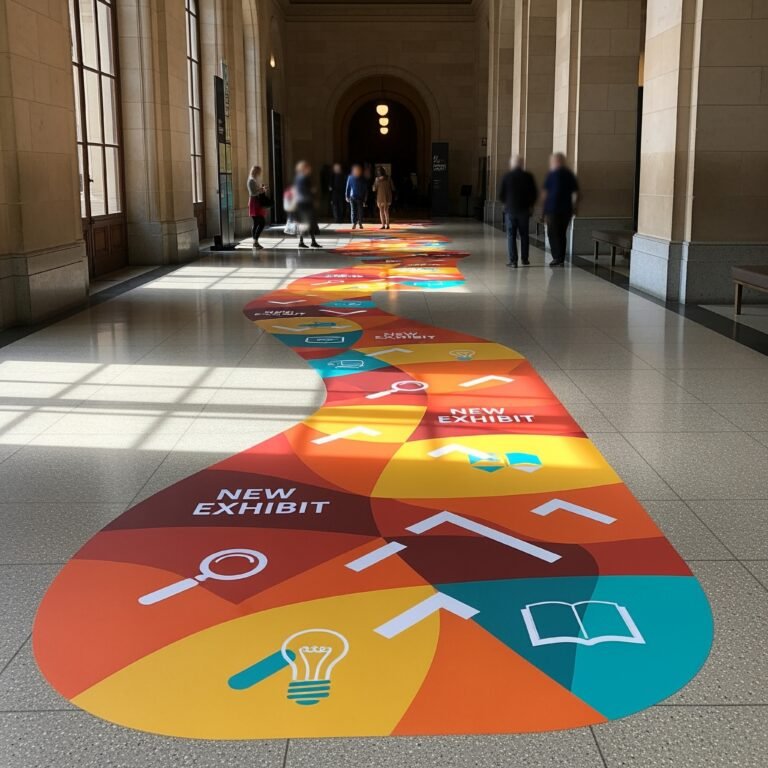
Navigating an unfamiliar space is not always as easy as putting up a few signs. Visitors may overlook wall-mounted directions, especially in crowded environments where competing messages demand their attention. Meanwhile, the path directly in front of them naturally becomes part of their visual field as they move. This difference can influence how directional information is noticed and processed.
Wayfinding floor graphics use this overlooked communication surface to place useful cues directly along a visitor’s route. But what actually happens when the brain encounters information on the ground instead of at eye level? This blog explores the psychology, visual attention, and practical benefits behind ground-level wayfinding.
Your Brain Filters Visual Information Before You Notice It
Before we get to the ground, let’s talk about why eye-level signage struggles in the first place. The average adult processes an overwhelming amount of visual data every second — faces, products, price tags, other people, phone screens. Your brain triages this information constantly, deciding what deserves conscious attention and what gets filtered out as irrelevant clutter. Signs competing at eye level are fighting for a very limited amount of cognitive real estate, and most of them lose.
Why Ground-Level Signage Feels More Intuitive
Walking is not a passive activity for your brain, it’s an active, safety-driven task. Long before you consciously register anything else in a room, your visual system is scanning the ground in front of you to avoid tripping, stepping in something, or bumping into an obstacle. This is instinctual, almost reflexive, wired in from millions of years of navigating uneven terrain.
Because of this built-in vigilance, ground-level information gets processed through a different mental pathway than eye-level content. Eye-level signs require deliberate, top-down attention, you have to consciously decide to look up and read them.
Floor-based cues, on the other hand, piggyback on an attention system that’s already switched on and actively working, whether you’re thinking about it or not. Your brain isn’t asking “should I look down?” it’s already looking down, constantly, as a survival habit.
This is precisely why well-designed wayfinding floor graphics tend to outperform overhead or wall-mounted signage in cluttered environments. They don’t compete for attention in the same crowded lane as everything else; they use a lane that’s essentially always open.
How Walking Patterns Influence Floor Graphic Visibility
There’s also a simple physics-of-vision angle here. Human peripheral vision naturally skews downward while walking, it’s part of how we maintain balance and pace. Combine that with the fact that people are increasingly looking at their phones, and upward-facing signage has an even tougher job competing for attention.
Ground-level graphics sit squarely inside that natural downward field of view, making them harder to miss, not because they’re louder, but because they’re better positioned relative to how people actually move through space.
The Design Science Behind Effective Floor Cues
Understanding the science doesn’t mean slapping an arrow on the floor and calling it done. Effective ground-level graphics need bold contrast, durable materials that survive foot traffic, and messaging simple enough to register in a split second of downward glance. Overcomplicate it, and you lose the very advantage that made floor-level placement effective in the first place.
The Bottom Line
At Cedar Prints, we design custom floor graphics that lean into exactly this kind of thinking: bold, clear, and built to work with how people naturally move and look, not against it.
Whether it’s wayfinding floor graphics guiding visitors through a busy retail layout, promotional decals highlighting a product launch, or branded flooring reinforcing your space’s identity.
We create graphics that get noticed because they’re placed where attention already lives. The floor has always been part of your space. It’s about time it started doing some of the talking.